

The term “Moor” has been woven into the historical fabric of Europe for centuries, conjuring images of African influence, military prowess, and cultural impact. Originating from the Greek word “mavro,” meaning “black” or “blackened,” the term was used by the ancient Romans and Greeks to describe indigenous Africans. Contrary to modern misconceptions, the word “Moor” is not simply a synonym for “Islamic” or indicative of any specific Arab or African ethnicity. It is firmly rooted in history, reflecting the complex interactions and interconnections between African and European civilizations.
The evolution of the term from its Greek origins to its later Latin form, “Maurus,” underscores its significance in ancient times. The plural form “Mauri” was employed by the Romans to specifically refer to Black Africans, solidifying its use as a racial identifier in both Greek and Latin literature. Even early English-Latin dictionaries, such as John Etick’s “A new English-Latin dictionary” from 1783, equated “Maurus” with “Moor,” “negro,” and “Aethiops,” emphasizing its association with black individuals.
Throughout history, the term “Moor” transcended linguistic boundaries, appearing in various European languages, including Spanish, German, and Dutch, where it continued to denote Black Africans. This linguistic continuity is corroborated by entries in English dictionaries and encyclopedias prior to the 20th century, such as Samuel Johnson’s “A Dictionary of the English Language” from 1768, which defined “Moor” as “negro” or “black-a-moor.”
The multifaceted presence of Moors in ancient and medieval European history is a testament to their enduring impact on the continent. From the Roman army’s recruitment of Moors for their exceptional combat skills to the veneration of African Catholic saints, such as St. Maurice, the Moors left an indelible mark on European societies. The association of Moors with significant historical figures and events, from Aemilianus to General Tarik ibn Ziyad al-Gibral, underscores their widespread influence across different epochs.

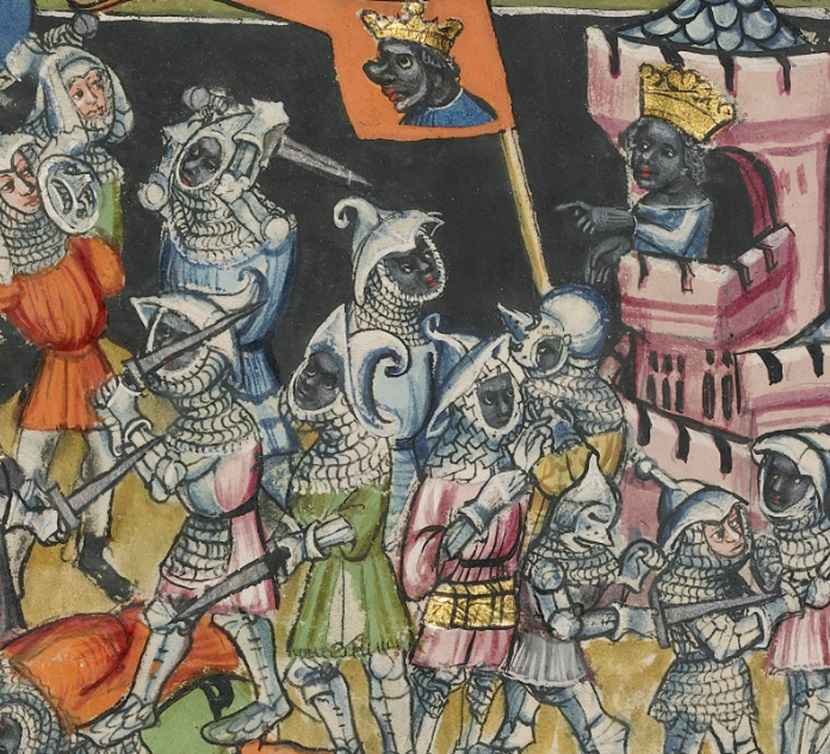


In the annals of European literature and art, the depiction of Moors occupies a prominent place, reflecting the interplay of cultural exchange and conflict. Texts like the “Song of Roland” and “The Four Sons of Aymon” feature vivid portrayals of Moorish leaders and heroes, highlighting the interconnectedness of European and Moorish narratives. These representations not only shed light on the military engagements between Moors and Christian rulers but also reveal the racial prejudices and stereotypes prevalent in medieval Europe.
The convergence of Moors and Christianity in historical narratives further underscores the complexity of their interactions. Manuscripts like the “Cantigas de Santa Maria” and the “Vidal Mayor” depict scenes of Moors’ conversion to Christianity, reflecting the religious and ideological transformations during that era. These accounts serve as a testament to the synthesis of diverse beliefs and the impact of religious dynamics on the perception of the Moors in European societies.
The visual representation of Moors in European heraldry and coat of arms attests to their enduring presence and authority in medieval Europe. The “Freising Moor,” depicted on various coats of arms, symbolizes the Moors’ elevated status and their integral role in European nobility. Through these heraldic symbols, the legacy of the Moors as esteemed members of European society is preserved, transcending geographical and temporal boundaries.
The expulsion of Moors from the Iberian Peninsula in the late 15th century marked a significant turning point in their historical trajectory. As Catholic rulers sought to consolidate religious authority, the mass exodus of Moors from Spain and Portugal led to their dispersal across Europe. Despite these upheavals, the influence of Moorish heritage endured, as evidenced by the integration of Moorish noble families into European societies and their lasting impact on European nomenclature.
The legacy of the Moors reverberates through the linguistic and cultural imprints they left on European history. Surnames such as Moore, Morris, Morrison, and Schwarz serve as linguistic testaments to the African ancestry of noble Moorish families, embodying the enduring link between African heritage and European society. The visual representations of African individuals in family crests and coat of arms, such as the “Schwarzkopf” in German heraldry, underscore the acknowledgment of African lineage within European cultural symbols.
In conclusion, the Moors’ narrative weaves an intricate tapestry of interconnected histories, encompassing military valor, religious transformation, and enduring cultural influence. Their presence in ancient and medieval European societies transcended the confines of traditional historical accounts, leaving an indelible mark on art, literature, and heraldry. The enduring legacy of the Moors serves as a testament to the intricate interplay of African and European civilizations, underscoring the richness and complexity of their shared history.
Here are two videos diving deeper into the topic of the Moors
Disclosure: This post contains affiliate links. If you buy through them, I may earn a small commission—at no extra cost to you. Thanks for supporting the site!

Jamaican Song and Story: Annancy Stories, Digging Sings, Ring Tunes, and Dancing Tunes.
$3.95 (as of March 25, 2026 02:41 GMT +00:00 - More infoProduct prices and availability are accurate as of the date/time indicated and are subject to change. Any price and availability information displayed on [relevant Amazon Site(s), as applicable] at the time of purchase will apply to the purchase of this product.)
Black AF History: The Un-Whitewashed Story of America―The New York Times Bestselling Retelling of US History Through the Experiences of Black Americans
$20.99 (as of March 25, 2026 02:41 GMT +00:00 - More infoProduct prices and availability are accurate as of the date/time indicated and are subject to change. Any price and availability information displayed on [relevant Amazon Site(s), as applicable] at the time of purchase will apply to the purchase of this product.)
Historical Study of Women in Jamaica, 1655-1844 (Caribbean History)
$35.95 (as of March 25, 2026 02:41 GMT +00:00 - More infoProduct prices and availability are accurate as of the date/time indicated and are subject to change. Any price and availability information displayed on [relevant Amazon Site(s), as applicable] at the time of purchase will apply to the purchase of this product.)
Lwas & Veves: A Beginner’s Guide to Haitian Voodoo Deities and Symbols
$9.99 (as of March 25, 2026 02:41 GMT +00:00 - More infoProduct prices and availability are accurate as of the date/time indicated and are subject to change. Any price and availability information displayed on [relevant Amazon Site(s), as applicable] at the time of purchase will apply to the purchase of this product.)
História da Congregação Cristã no Brasil: Em nome do Senhor Jesus (Portuguese Edition)
$6.99 (as of March 25, 2026 02:41 GMT +00:00 - More infoProduct prices and availability are accurate as of the date/time indicated and are subject to change. Any price and availability information displayed on [relevant Amazon Site(s), as applicable] at the time of purchase will apply to the purchase of this product.)
The Jamaica Reader: History, Culture, Politics (The Latin America Readers)
$17.02 (as of March 25, 2026 02:41 GMT +00:00 - More infoProduct prices and availability are accurate as of the date/time indicated and are subject to change. Any price and availability information displayed on [relevant Amazon Site(s), as applicable] at the time of purchase will apply to the purchase of this product.)
Inward Hunger: The Education of a Prime Minister
$24.95 (as of March 25, 2026 02:41 GMT +00:00 - More infoProduct prices and availability are accurate as of the date/time indicated and are subject to change. Any price and availability information displayed on [relevant Amazon Site(s), as applicable] at the time of purchase will apply to the purchase of this product.)
Rastafari: From Outcasts to Cultural Bearers
$39.51 (as of March 25, 2026 02:41 GMT +00:00 - More infoProduct prices and availability are accurate as of the date/time indicated and are subject to change. Any price and availability information displayed on [relevant Amazon Site(s), as applicable] at the time of purchase will apply to the purchase of this product.)
In Miserable Slavery: Thomas Thistlewood in Jamaica, 1750-86
$9.99 (as of March 25, 2026 02:41 GMT +00:00 - More infoProduct prices and availability are accurate as of the date/time indicated and are subject to change. Any price and availability information displayed on [relevant Amazon Site(s), as applicable] at the time of purchase will apply to the purchase of this product.)
One thought on “African Moors: The True History and Legacy of the Term “Moor” in European Culture”