

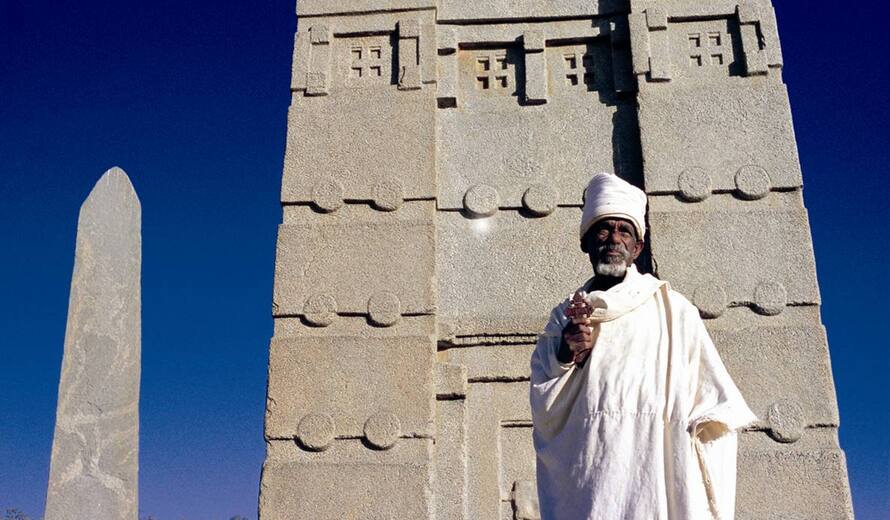
The Kingdom of Aksum, also referred to as the Kingdom of Axum or the Aksumite Empire, held sway over a vast territory in East Africa and South Arabia from the era of Classical antiquity through the Middle Ages. Nestled in what is now Northern Ethiopia and Eritrea, the kingdom’s influence stretched across present-day Djibouti and Sudan, even extending into Southern Arabia during the rule of Kaleb, one of its notable kings.
As Aksum emerged as a dominant force along the trade route linking Rome and India, it secured a virtual monopoly over Indian Ocean trade, propelling it into the Greco-Roman cultural sphere. This strategic positioning contributed to Aksum’s recognition as one of the four great powers of the 3rd century, as noted by the Persian prophet Mani, placing it alongside Persia, Rome, and China in terms of influence and impact.
The kingdom’s economic prowess and political reach are underscored by the fact that during the reign of Endubis, Aksum commenced minting coins that have been unearthed as far afield as Caesarea and southern India, attesting to its wide-ranging commercial connections. Further still, under the leadership of Gedara, Aksum ventured into South Arabian affairs early in the 3rd century, signaling its expanding sphere of influence and diplomatic engagements.
With a trajectory of expansion that persisted through late antiquity, Aksum achieved notable milestones such as the conquest of Kush under the rule of King Ezana in 330, albeit for a brief period. This conquest bestowed upon Aksum the Greek exonym “Ethiopia,” a testament to the kingdom’s far-reaching impact and the complex interplay of cultures in its domain.
A pivotal chapter in Aksum’s history unfolded during the reign of Kaleb of Axum, when, prompted by the Byzantine Emperor Justin I, the kingdom embarked on an invasion of the Himyarite Kingdom in Yemen. This intervention sought to halt the persecution of Christians orchestrated by the Jewish king Dhu Nuwas, thereby cementing Aksum’s role as a significant player in regional affairs.
Notably, Aksum reached its zenith in territorial expanse following the annexation of Himyar, which saw the kingdom’s domain swell to around 2,500,000km². However, this expansive territory was not without its challenges, as evidenced by the territorial losses suffered in the conflicts known as the Aksumite–Persian wars.
In sum, the Kingdom of Aksum stands as a testament to the dynamic interplay of power, trade, and cultural exchange in the ancient world, leaving a rich legacy of influence and achievement that reverberates across the annals of history.

Disclosure: This post contains affiliate links. If you buy through them, I may earn a small commission—at no extra cost to you. Thanks for supporting the site!

The Man-Eaters of Tsavo, and Other East African Adventures
$15.91 (as of March 24, 2026 05:47 GMT +00:00 - More infoProduct prices and availability are accurate as of the date/time indicated and are subject to change. Any price and availability information displayed on [relevant Amazon Site(s), as applicable] at the time of purchase will apply to the purchase of this product.)
Shake Hands with the Devil: The Failure of Humanity in Rwanda
$12.99 (as of March 24, 2026 05:47 GMT +00:00 - More infoProduct prices and availability are accurate as of the date/time indicated and are subject to change. Any price and availability information displayed on [relevant Amazon Site(s), as applicable] at the time of purchase will apply to the purchase of this product.)
In the Company of Heroes: The Personal Story Behind Black Hawk Down
$17.00 (as of March 24, 2026 05:47 GMT +00:00 - More infoProduct prices and availability are accurate as of the date/time indicated and are subject to change. Any price and availability information displayed on [relevant Amazon Site(s), as applicable] at the time of purchase will apply to the purchase of this product.)
The Kebra Nagast: The Lost Bible of Rastafarian Wisdom and Faith (The Essential Wisdom Library)
$17.71 (as of March 24, 2026 05:47 GMT +00:00 - More infoProduct prices and availability are accurate as of the date/time indicated and are subject to change. Any price and availability information displayed on [relevant Amazon Site(s), as applicable] at the time of purchase will apply to the purchase of this product.)
City of Thorns: Nine Lives in the World’s Largest Refugee Camp
$18.38 (as of March 24, 2026 05:47 GMT +00:00 - More infoProduct prices and availability are accurate as of the date/time indicated and are subject to change. Any price and availability information displayed on [relevant Amazon Site(s), as applicable] at the time of purchase will apply to the purchase of this product.)
ETHIOPIAN BIBLE IN ENGLISH COMPLETE: The Complete English Translation of the Ancient Ethiopian Canon, Including Enoch, Jubilees, and the Apocrypha
$1.99 (as of March 24, 2026 05:47 GMT +00:00 - More infoProduct prices and availability are accurate as of the date/time indicated and are subject to change. Any price and availability information displayed on [relevant Amazon Site(s), as applicable] at the time of purchase will apply to the purchase of this product.)
The Devil Came on Horseback: Bearing Witness to the Genocide in Darfur
$15.91 (as of March 24, 2026 05:47 GMT +00:00 - More infoProduct prices and availability are accurate as of the date/time indicated and are subject to change. Any price and availability information displayed on [relevant Amazon Site(s), as applicable] at the time of purchase will apply to the purchase of this product.)
Emancipation without Abolition in German East Africa, c. 1884–1914 (Eastern African Studies)
$34.95 (as of March 24, 2026 05:47 GMT +00:00 - More infoProduct prices and availability are accurate as of the date/time indicated and are subject to change. Any price and availability information displayed on [relevant Amazon Site(s), as applicable] at the time of purchase will apply to the purchase of this product.)
Operation Thunderbolt: Flight 139 and the Raid on Entebbe Airport, the Most Audacious Hostage Rescue Mission in History
$14.20 (as of March 24, 2026 05:47 GMT +00:00 - More infoProduct prices and availability are accurate as of the date/time indicated and are subject to change. Any price and availability information displayed on [relevant Amazon Site(s), as applicable] at the time of purchase will apply to the purchase of this product.)